Scalable AI Mental Health Support for Teams
- The Founders

- Mar 22
- 7 min read
Supporting the mental health of employees used to be treated as a quiet benefit - something tucked away in a benefits portal, rarely discussed openly. Companies often relied on traditional Employee Assistance Programs (EAPs), hoping that simply offering access to therapy resources would be enough.
But the world of work has changed.
Stress levels are higher. Teams are more distributed. Roles are more complex. The emotional demands placed on employees have grown dramatically and they don’t disappear when the workday ends.
Today, mental health support isn’t a “nice-to-have.” It’s foundational to performance, retention, and culture. And not just at the individual level but at the team level.
The challenge? Most traditional mental health solutions don’t scale.
Therapy is invaluable but limited in availability. HR teams are stretched thin. Managers aren’t trained to navigate emotional conversations at depth. And many employees hesitate to seek help because they fear stigma, judgment, or career consequences.
This is where AI-driven wellness companions like GRACE offer something new. They provide emotionally intelligent, always-available, private support that can scale across entire organizations.
This article explores why scalable mental health support matters, what teams truly need, and how AI companions can transform emotional wellbeing in modern workplaces.

Why Teams Need Mental Support (AI or other)
Workplaces today are more complex than ever.
Teams are global, hybrid, remote, cross-functional, and constantly adapting to change. Technology moves quickly. Markets shift. Expectations evolve. Communication never fully stops.
With that complexity comes emotional strain.
Employees often describe:
Feeling overwhelmed by workload
Struggling with burnout
Navigating unclear expectations
Managing blurred work-life boundaries
Feeling isolated in remote environments
Experiencing anxiety around performance reviews
Carrying personal stress while trying to stay productive
These challenges don’t just affect individuals. They ripple across teams.
When one person is burned out, collaboration suffers. When anxiety rises, communication tightens. When morale dips, creativity declines.
Emotional wellbeing is contagious - in both directions.
The Cost of Ignoring Mental Health
When mental health isn’t actively supported, the consequences are measurable.
Teams experience:
Higher turnover
Lower engagement
Reduced productivity
Increased interpersonal conflict
More sick days
Poorer collaboration
Lower morale
These aren’t abstract metrics. They show up in everyday realities:
Missed deadlines. Short tempers. Passive disengagement. Quiet quitting. A culture that feels heavy instead of energized.
And perhaps most costly of all - talented employees slowly losing motivation.
Organizations invest heavily in hiring and training. But without emotional support, that investment quietly erodes.
The Problem with Traditional Solutions
Most companies rely on a familiar toolkit:
EAP programs
Occasional wellness workshops
Manager training sessions
Mental health awareness days
Internal newsletters
One-off resilience seminars
These efforts are well-intentioned. But they often miss a critical factor: continuity.
Mental health isn’t solved in a workshop. It’s lived daily.
Traditional support models face several limitations:
Limited accessibility - Therapy appointments are scheduled and finite. Stigma barriers -Employees worry about confidentiality. Time constraints - Busy teams rarely prioritize proactive support. Manager overload - Leaders aren’t therapists. Inconsistent quality - Human support varies by skill and capacity.
What teams need isn’t occasional intervention. They need ongoing, scalable, emotionally safe support embedded into everyday workflows.
What “Scalable” Really Means
Scalability isn’t just about reaching more employees.
It means offering support that:
Works for teams of 10 or 10,000
Adapts to different roles and schedules
Supports employees across time zones
Doesn’t rely on human availability
Maintains consistent quality
Protects privacy and anonymity
Fits naturally into daily work rhythms
A scalable solution enhances human care - it doesn’t replace it.
It fills the gaps between therapy sessions. Between manager check-ins. Between HR touchpoints.
It’s present in the moments when stress actually happens.
The Role of AI in Team Wellbeing
AI wellness companions like GRACE introduce a new model of support - one built around accessibility, emotional intelligence, and personalization.
Here’s what makes this approach transformative.
1. Always Available
Stress doesn’t operate on business hours.
Employees may need support:
Late at night before a deadline
Early morning before a presentation
Between back-to-back meetings
During business travel
On weekends
In moments when they don’t want to involve a manager
An AI companion is available 24/7.
This removes one of the biggest barriers to mental health support: timing.
Employees don’t have to wait until a crisis builds. They can process stress in real time.
2. Emotionally Intelligent Responses
Modern AI companions are designed to:
Recognize emotional cues
Respond with empathy
Offer grounding techniques
Guide cognitive reframing
Support emotional regulation
That emotional intelligence is critical.
Employees don’t want robotic advice. They want to feel heard.
When support feels emotionally attuned, engagement increases - and so does trust.
3. Anonymous and Judgment-Free
Stigma remains a major barrier to seeking help.
Employees may fear:
Being perceived as weak
Damaging their professional reputation
Being misunderstood
Confidentiality breaches
An AI wellness companion offers private, anonymous interaction.
There is no performance evaluation. No career consequence. No social pressure.
That safety often encourages people to open up sooner — before stress escalates.
4. Consistent Quality Across Teams
Human support is powerful — but variable.
Some managers are emotionally skilled. Others are still learning. Some HR teams have capacity; others are stretched thin.
AI support offers consistency.
Every employee receives:
The same emotional intelligence
The same grounding tools
The same availability
The same privacy standards
That consistency is essential for large or distributed teams.
5. Personalized Support
Scalable doesn’t mean generic.
AI companions can learn patterns over time:
What triggers an employee’s stress
What coping tools work best
How they communicate
When they typically struggle
This personalization creates meaningful support - without requiring manual oversight.
Employees feel seen, not processed.
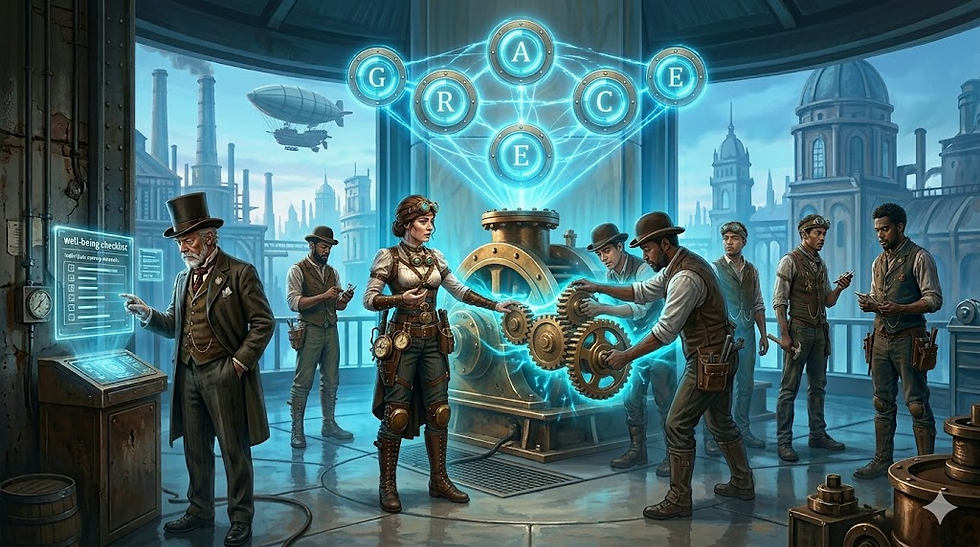
How GRACE Supports Teams in Real Life
To understand impact, it helps to imagine real workplace scenarios.
1. High-Pressure Projects
Deadlines and launches create emotional spikes.
During intense sprints, employees may feel:
Anxiety
Imposter syndrome
Overwhelm
Mental fatigue
GRACE can help employees:
Break large tasks into manageable steps
Reframe catastrophic thinking
Regulate anxiety through breathing exercises
Process frustration privately
This reduces emotional build-up - and prevents burnout before it takes root.
2. Remote and Hybrid Teams
Remote work offers flexibility — but also isolation.
Employees may feel:
Disconnected from colleagues
Overlooked in meetings
Lonely between interactions
Unsure how they’re perceived
An AI companion offers daily presence.
Even small check-ins can:
Reinforce emotional awareness
Provide a sense of connection
Encourage healthy boundaries
Reduce isolation
That sense of ongoing support matters deeply in distributed environments.
3. Global Teams Across Time Zones
In global organizations, leaders can’t be available around the clock.
Employees working in different regions may feel unsupported during their workday.
AI support bridges that gap with:
24/7 availability
Multilingual communication
Cultural adaptability
Consistent experience regardless of location
This levels the playing field.
4. Organizational Change
Change creates emotional turbulence.
Layoffs, restructuring, leadership transitions, mergers - these events generate uncertainty and fear.
Employees may experience:
Anxiety about job security
Distrust
Grief
Loss of motivation
An AI companion provides a private space to process those emotions.
That emotional processing stabilizes morale and reduces reactive behaviors.
5. Supporting Managers Themselves
Managers often absorb emotional pressure from both above and below.
They navigate:
Performance concerns
Conflict mediation
Leadership expectations
Team morale
But who supports them?
AI wellness companions provide managers with:
Emotional clarity
Stress regulation tools
Reflective decision support
A private space to decompress
Healthy managers create healthy teams.
Organizational Benefits of Scalable Support
When teams have consistent emotional support, organizations see measurable improvements.
1. Higher Engagement
Emotionally supported employees are more:
Motivated
Focused
Creative
Collaborative
Engagement rises not because of incentives - but because people feel psychologically safe.
2. Lower Burnout Rates
Burnout isn’t just exhaustion. It’s emotional depletion.
By helping employees regulate stress daily, AI support reduces chronic build-up.
Small resets prevent large collapses.
3. Improved Collaboration
Emotionally grounded employees communicate more clearly.
They:
React less defensively
Handle feedback better
Resolve conflict more constructively
Show greater empathy
This strengthens team cohesion.
4. Reduced Turnover
When employees feel supported holistically, loyalty increases.
Replacing talent is expensive. Retaining emotionally healthy employees is sustainable.
5. Stronger Organizational Culture
Culture isn’t built through slogans. It’s built through lived experience.
When emotional wellbeing is normalized and supported:
Compassion increases
Psychological safety grows
Trust strengthens
Resilience improves
Organizations become more human - without sacrificing performance.

Why AI Doesn’t Replace Human Care
It’s important to clarify: AI wellness companions are not therapists.
They don’t diagnose.They don’t replace professional mental health treatment.They don’t substitute for leadership.
Instead, they complement existing systems.
Employees still need:
Therapists
Coaches
Managers
HR support
Meaningful human relationships
AI fills the spaces in between.
The moments late at night. The emotional spike between meetings. The quiet doubt before a big presentation.
Those micro-moments are where resilience is built.
Integrating GRACE Seamlessly into Teams
The beauty of scalable AI support is that it requires minimal disruption.
Integration can look like:
Offering access during onboarding
Encouraging optional daily check-ins
Including it in wellness initiatives
Sharing it as a resource during high-pressure periods
Normalizing emotional awareness conversations
Making it accessible across devices
There’s no need to mandate usage.
When support is safe and helpful, adoption happens naturally.
The Future of Team Wellbeing
The future of workplace mental health is not reactive.
It’s:
Proactive
Continuous
Accessible
Personalized
Emotionally intelligent
Scalable
As workplaces continue to evolve - becoming more digital, more global, and more dynamic - emotional demands will not decrease.
Support systems must evolve alongside them.
AI companions like GRACE represent a shift from episodic care to daily resilience-building.
They empower employees to:
Understand their emotional patterns
Regulate stress in real time
Make clearer decisions
Maintain healthier boundaries
Feel less alone in their challenges
And when individuals grow stronger emotionally, teams grow stronger collectively.
Closing Thought: Scaling Humanity, Not Just Productivity
Organizations often focus on scaling systems, output, and efficiency.
But scaling humanity may be the most important evolution yet.
Scalable mental health support ensures that as companies grow, emotional wellbeing doesn’t get left behind.
It creates workplaces where:
People can perform - without sacrificing themselves. Leaders can lead — without burning out. Teams can collaborate - without carrying silent strain.
In the modern workplace, emotional wellbeing isn’t separate from performance.
It drives it.
And scalable, AI-supported care makes that support accessible to everyone - not just the few who feel comfortable asking for it.
That’s the future of team wellbeing.


Comments